2026 Essay · Simonides project
The memory palace was the first page table
Virtual memory outside the computer: a design two thousand years old, a mechanism in the brain, and the traffic that runs both ways.
01 The claim
A computer with virtual memory lets a program use more memory than the machine has. The program names what it wants. A table turns each name into a place in the real memory, or reports that the thing is not there. If it is not there, the program stops, the thing is fetched from a slower, larger store, the table is corrected, and the program goes on as if nothing had happened. Something else has to leave to make room, and a rule chooses what. The program never learns where anything is. It does not need to.
I think this arrangement is not special to computers. It can be found in real life. This essay makes the case in four parts. First, the oldest designed version, which is Roman and two thousand years old. Second, what the computer version actually is, from the people who built and defined it, so that the claim can be tested rather than felt. Third, the brain, where the evidence is now good that one organ holds an index and not the content. Fourth, two lines of research that took their central idea from computer storage and ran it on people, and the one experiment that tried to treat memory as a cache and found it was not one.
The honest result is sharper than the claim. What computers call virtual memory is a bundle of five things. Outside the computer, the whole bundle is found in warehouses and library depositories, where engineers built it on purpose. In the brain, the index and the fault are found, and a rule for what fades, but not a bounded store with eviction. The memory palace is the oldest designed version of the index. And a few things that look like virtual memory, a bank’s reserves, an inducible gene, a factory that pulls parts on demand, carry one piece of the bundle only. One piece is caching, or demand supply. All five is virtual memory.
02 Simonides and the fixed places
The story is told by Cicero and retold by Frances Yates [1]. Simonides of Ceos, a poet, recites an ode at a banquet. He is called outside. The roof falls in and crushes the guests past recognition. Simonides identifies each body by remembering where each guest had sat. From this, the story says, he drew the art of memory: fix places in the mind, put images of the things to be remembered in them, and walk the places to recover the things.
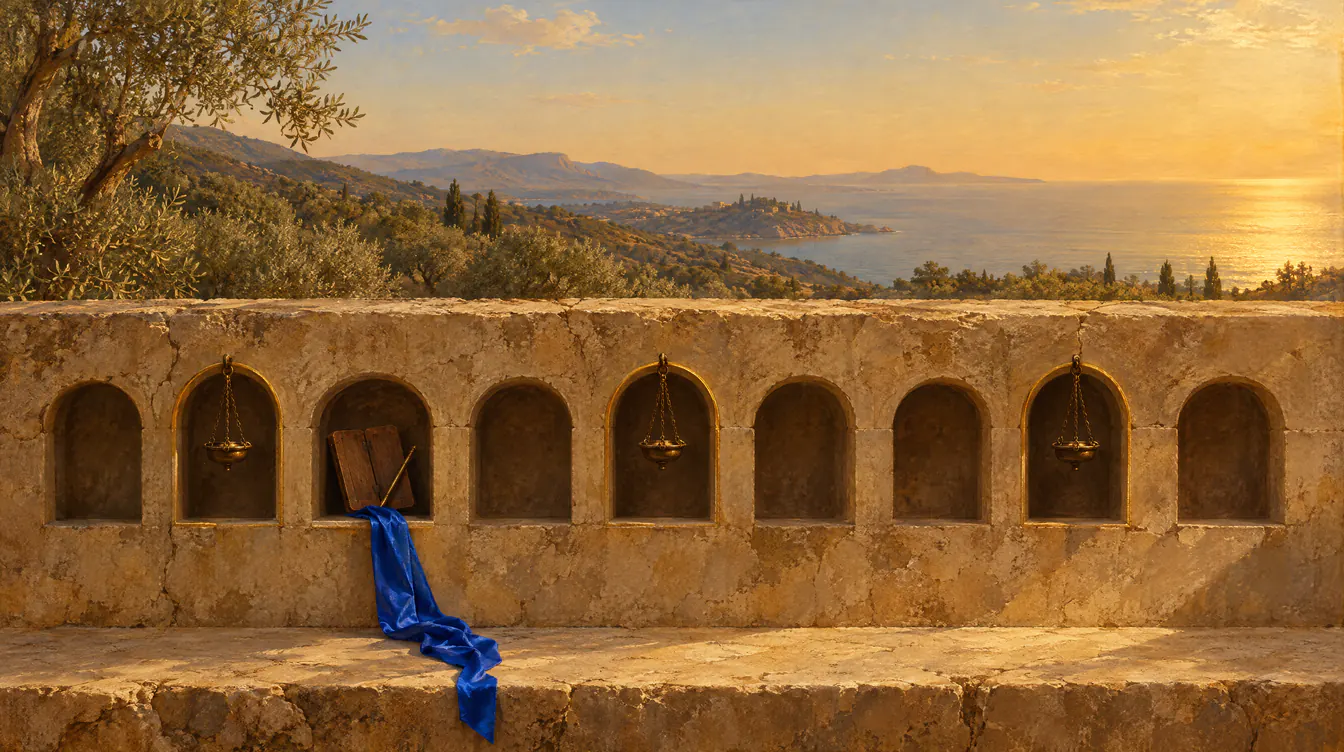
The fullest ancient manual is the Rhetorica ad Herennium, an anonymous Latin handbook from the 80s BCE. Its memory chapters are short and practical [2]. The places, which the translator calls backgrounds, are “very much like wax tablet or papyrus, the images like letters”. The two parts have different lives: the images “are effaced when we make no use of them, but the backgrounds, like wax tablets, should abide”. The backgrounds are to be laid out “in a series”, so that the walk gives the order of the speech, and “each fifth background should be marked”, so that a speaker can jump to the twentieth place without counting from the first. They should be of “moderate size”, neither too bright nor too dim, and found “in a deserted than in a populous region”, so that passing crowds do not disturb the images.
Read that with a computer in mind and the structure is familiar. There is a fixed, numbered set of places, which is the frame set. There is content that is written into the places and erased from them, which is the pages. The places outlive any one speech and are reused for the next one, which Denning would later call folding: one location holding different names at different times. The series gives what Denning called artificial contiguity: items that belong together in the speech sit next to each other in the walk, whatever their order in the world. And there is a replacement rule, stated plainly: what is not used is effaced. The marked fifth place is a small index into the index.
Two things are missing, and they matter. There is no fault. When the orator reaches a place and the image is gone, nothing fetches it from a slower store; the speech simply fails there. And there is no system below the user. The orator builds the palace, chooses the places, writes the images and walks the route himself. In the computer the whole point is that the program never does any of this. So the memory palace is a designed address space with swappable contents, and it is a technique, not a mechanism. It proves that the design is old. It does not prove that nature uses it.
The Greeks had already described the thing the palace lacks. In the Theaetetus Socrates separates two ways of having knowledge [3]. “Having does not seem to me the same as possessing.” A man who has caught wild birds and keeps them in an aviary at home “always has them because he possesses them”, and yet, at any moment, “has none of them” in hand. To use one he must hunt it again, inside his own enclosure. There are therefore two hunts, “one before the acquisition for the sake of possessing, the other carried on by the possessor for the sake of taking and holding in his hands what he had acquired long before”. The second hunt is the fault: the thing is in the store, it is not at hand, and getting it costs time and can fail. Augustine, five centuries later, describes the same thing from the inside [4]. Some things come at once when asked for. Some “require to be searched for longer, and then dragged out, as it were, from some hidden recess”. Others, not asked for, “hurry forth in crowds” while the sought thing is searched for, and have to be brushed away. That is the latency of a miss, and the eviction of the crowd, written down in about 400 CE.
03 What the computer did, exactly
The computer version was built at Manchester between 1959 and 1962, on the Atlas, and its designers called it the one-level store [5, 6]. Peter Denning, who later gave the field its theory, put the invention in one sentence: it rested on “a distinction between address and memory location” [7]. From that distinction came three things. Hardware translated every address the processor produced into its current location. A missing page raised an interrupt, which fetched it from the drum into the 512-word core pages; this was demand paging. And a replacement algorithm, “a learning program”, chose which pages to move out, aiming at “the least useful pages”. The programmer, who until then had planned by hand which parts of a program would overlay which, was given “the illusion of having a very large fast memory”. The illusion was doubted for years. In 1969 David Sayre’s team at IBM measured that the automatic method moved fewer pages than the best manual overlays [8], and the argument ended. Denning adds a point that is easy to forget: the same machinery solved “the more critical memory protection problem”, because a program that can only name things in its own address space cannot touch anyone else’s.
Denning’s survey of 1970 made the thing precise [9]. There is an address space N, the set of names a program may use, and a memory space M, the set of locations the hardware has, with more names than locations. A map f gives, for a name, its location “if item a is present in M, and a missing-item fault otherwise”. The fault stops the program until the item is brought in from auxiliary memory, placed somewhere, and the map rewritten; if M is full, some item leaves “at the discretion of the replacement rule”. The policies, he says, come in three classes: replacement decides what leaves, fetch decides when things load, on demand or ahead of need, and placement decides where they go. And a virtual memory “is more than mere mechanism; it necessarily includes the policies whereby the mechanisms are used”. Two more ideas complete the picture. Programs show locality: at any time they use a small, slowly changing set of pages, their working set, and a program should run only if its working set fits; when the working sets of all running programs do not fit, the machine thrashes, which Denning defined as a collapse of performance. And a name space is folded when one location has held different names over time.
That gives a checklist, and the rest of this essay uses it. A system shows virtual memory when it shows all of these: two spaces, with more names than places; a map kept by the system and not by the user; a fault, where the user waits while the item comes from the slow store; a fetch policy; a placement policy; a replacement policy, by use; a working set, with thrashing when it does not fit; and folding and protection, where a place holds different names over time and name spaces cannot reach each other. The memory palace has the two spaces, the map, the placement, the replacement and the folding. It lacks the fault and anything working below the user. The question for the brain is which of the eight it has.
04 An organ that holds the index and not the content
In 1986 Timothy Teyler and Pascal DiScenna proposed that the hippocampus does not store memories. It stores an index to them [10]. The content of an experience is registered where it was processed, across the neocortex. The hippocampus, which receives from all those regions and projects back to them, records which neocortical patterns were active together, and that record is enough: a partial cue that reaches the hippocampus reactivates the index, and the index reactivates the whole pattern. Twenty years later Teyler and Jerry Rudy reviewed the theory and found it had “aged very well” [11]. Their restatement is as plain as Denning’s. “The hippocampus itself does not contain the content of an experience but it does provide an index that allows the content to be retrieved.” And, with a little irony: “no content is being stored in hippocampus. The memory trace is the index.”
Two properties of that index are worth holding on to. It is cheap and quick to make, because it rests on a form of synaptic strengthening that is easily induced. And it is labile. “If the information is of no particular importance then either by natural degradation of these easily acquired connections or by interference produced by other stimulus inputs, the index will be lost. However, if the content of the experience is significant and/or repeated the index will be resistant to decay.” That is a replacement rule for the index itself, stated by use and by weight. The authors add that “most of what is initially stored is of little importance and will be forgotten”. A page table that forgets its entries unless they are used is not a bad description of a day’s memory.
The theory was abstract in 1986. The evidence that it describes something physical came with tools to tag and drive the cells active during an experience. If the hippocampal trace is an index, then breaking the index should leave the content in place, and reaching the content by another route should bring the memory back. That is what Tomás Ryan and colleagues reported in 2015 [12]. Mice were trained to fear a context and then given a drug that blocks protein synthesis, which produces amnesia: the natural cue, the context itself, no longer brought the fear. But the cells that had been active during learning had been tagged, and driving them directly with light brought the fear back. Susumu Tonegawa, the senior author, said it plainly: amnesia here “is a problem of retrieval impairment”. The 2017 paper from the same group named the state a silent engram [13]. In Denning’s terms, the item is in M, the map has lost its entry, and addressing the location directly goes round the map. That is the difference between a lost page and a lost page-table entry, found in a mouse.
The clearest picture of the index as a table of entries comes from birds. A Clark’s nutcracker stores about 32,000 pine seeds in a year, three to five times what it needs, in more than a thousand caches, and recovers them into the following summer [14]. In an aviary with the obvious cues removed, the birds found their caches by spatial memory; when the landmarks were moved, the places they searched moved by the same amount [15]. The store is the ground. The map is in the bird. In 2024 Selmaan Chettih and colleagues recorded from the hippocampus of chickadees as they cached and retrieved seeds [16]. Each caching event produced a sparse pattern of activity, about a second long, over seven per cent or fewer of the neurons recorded, unique to that event. The same pattern came back when that cache was retrieved. The patterns were uncorrelated even for neighbouring caches with similar place codes. The authors call them barcodes and propose that they are memory indices: one unique identifier per event, kept apart from the map of space. I do not know a closer natural picture of a page-table entry.
Then there is the question of what happens to the index over time. The dominant theory of consolidation says that the hippocampus holds a memory first and the neocortex learns it slowly, by repeated reinstatement, until the hippocampus is no longer needed for it [17]. The reinstatement has been seen: the place cells that fired together while a rat ran a task fired together again in the slow-wave sleep that followed [18]. If that is right, the index is a staging record, and the content is written back from the fast store to the slow one while the animal is idle, which is exactly what a write-back cache does. But the index theory’s own authors are careful here. Whether the hippocampus is “no longer required for retrieval” after consolidation “is currently controversial”, they write, and “remains unsettled”, because some animal studies find that damage to the hippocampus disrupts place and context memories regardless of how old they are. So the folding of the index, its entries becoming free again once the content has moved, is possible and not shown.
What the brain does not show is as important. Nobody has found a placement policy, a rule for where a new memory goes. Nobody has found protection: the nutcracker’s caches are pilfered by other birds, and nothing stops one animal’s name space reaching another’s location. And the content does not come back bit for bit. A page is copied; a memory is rebuilt, and the rebuilding can go wrong in ways a copy cannot. The map transfers. The content does not.
05 Two lineages, and the experiment that said no
The two best-known theories of memory that use the vocabulary of storage did not borrow it loosely. They took it from computer storage on purpose, and said so.
The first is John Anderson’s rational analysis of memory. Its premise is that memory is a system managing “a huge stockpile” of items that cannot all be kept available, and that an optimal such system would make most available the items most likely to be needed [19]. Anderson and Robert Milson built the first model in 1989 “based on mathematical models that were developed to explain library borrowings and accesses to files in computer systems” [20]. Two years later Anderson and Lael Schooler replaced the argument by analogy with measurement [19]. They took three environments in which demands on memory can be counted: two years of New York Times headlines, speech addressed to children, and the senders of one person’s email. In each they asked how the probability that a word, or a sender, appears on day 101 depends on its history over the previous 100 days. The probability fell with time since the last appearance as a power law, with exponents of 0.73, 0.77 and 0.83, and rose in proportion to how often the item had appeared. Items that had appeared twice with a long gap between were more likely to recur after a long delay than items with a short gap. Then they showed that human retention, practice and spacing curves have the same shapes. Memory, they concluded, “has the form it does because it is adapted to these environmental relationships”. The forgetting curve is a need curve.
What kind of policy is that? Anderson and Schooler are explicit. Memories “are considered in order of their need probabilities until the need probability is so low that it no longer is worth considering any more.” Nothing is evicted. The store is unbounded, and retrieval stops when the expected gain is below the cost of looking. So it is a replacement rule in one sense and not in another: it ranks items by use, as Atlas’s learning program did, but it never has to make room.
The second lineage is Daniel Wegner’s transactive memory, the idea that a couple or a team keeps “a shared system for encoding, storing, and retrieving information”, in which what each member needs to know is not everything but who knows what [21, 22]. In the 1991 paper with Ralph Erber and Paula Raymond the source of the idea is stated. Computers with separate memories “can be programmed to share memory through the creation of a directory within each isolated memory system that contains an abbreviated record of the contents of other memory systems”. The epigraph is Samuel Johnson: “we know a subject ourselves, or we know where we can find information upon it.” The directory is a map from topics to people, and it is updated, they say, by negotiated entries (whoever does the bills becomes the repository of financial data), by perceived expertise, and by access cues: who got the information first, kept it longest, or used it most recently. Recency and frequency again, now as the rule of a directory. The experiment is small and clean. Fifty-nine dating couples studied 64 items in seven categories, either with their partner or with a stranger from another couple, with or without an assigned division of categories. Without an assignment, natural couples recalled 31.40 items against 27.64 for strangers; with an imposed assignment the order reversed, 23.75 against 30.14. A directory imposed from outside interferes with the one a couple already has. Twenty years later Betsy Sparrow, Jenny Liu and Wegner reported that people who expect to have access to information later recall the information less and where to find it more [23]. That is a page-table entry kept and a page dropped, though one of that paper’s four experiments, the reaction-time one, did not replicate [24, 25], and the memory experiments were not retested.
So the directory and the need rule both came from computers into theories of memory, and both found something real. That makes the next result the more important. In 2014 Avi Press, Michael Pacer, Thomas Griffiths and Brian Christian asked the question this essay is circling: what if human memory really is a cache [26]? “What if memory is finite, and a cost is incurred for failing to retrieve an item?” Then “forgetting is also obligatory, as new items force out old”, and the Anderson–Schooler strength becomes an eviction policy that can be run against the policies computer scientists use: least recently used, least frequently used, and their refinements, with a random policy as the floor and Belady’s clairvoyant algorithm, which evicts whatever will be needed furthest in the future, as the ceiling. They ran them all on the same headlines Anderson and Schooler had used, with a cache of 128 words.
The human rule did badly. It “performed similarly to the worst algorithms, being only slightly better than random eviction”. The frequency-based policies came closest to the clairvoyant one, and the recency-based one, which is the workhorse of real operating systems, had the steepest fall-off. The authors note the surprise: least-recently-used “generally outperforms” least-frequently-used on calls to computer memory, and here the order was reversed, which they put down to the very skewed frequencies of words and the weak locality of language. Only the human rule showed a spacing effect, and the clairvoyant optimum showed none, so spacing does not help a bounded cache on this data. Their conclusion reads against the premise of their own experiment: these findings “provide evidence that the assumption of infinite capacity may be more appropriate as the basis for a rational analysis”.
I take three things from that. The map transfers: the directory, the index, the silent engram are real. The use rule transfers: need falls with disuse in the world and in the head. The frame count does not, or not yet: nobody has shown that long-term memory is a bounded store that must evict, and the one attempt to model it as one found that the human rule is a poor eviction policy and that the data do not reward eviction. Working memory’s three to five chunks are a resident set [27], but they are the registers, not the frames.
06 What the bundle looks like when it is whole
There is one place outside the computer where all eight marks are present, and it is instructive because engineers put them there. A large warehouse does not keep each product in its own place. It puts any incoming item in any free slot, the closest one the worker can find, scans the item and the shelf, and lets a database remember [28, 29, 30]. The picker who later fetches it does not know where it is and does not need to; the system does. The slot holds something else tomorrow. Fast-moving items are kept near the point of demand, which is locality used on purpose. And the whole thing has a single point of failure: lose the database and nothing can be found, which is the silent engram at the scale of a building. Harvard’s library depository, thirty miles from the library, shelves ten million items by size rather than by subject, finds them by barcode, and answers a request the next business day [31, 32]. The call number is the name, the tray is the location, the depository is the slow store, and the request is the fault. The patron never addresses a shelf, which is protection. That is the full bundle, and it is a designed copy, like the memory palace. It proves the design works at human scale. It does not prove nature uses it.
Between the designed copies and the brain there is one more case, and it is the one I intend to measure. Laura Alessandretti and colleagues followed about 40,000 people through their phones for up to two years and found that the number of familiar places a person keeps, places visited at least twice with more than ten minutes a week over twenty weeks, is conserved at about 25 [33]. New places are adopted and old ones dismissed at the same rate, 30 to 50 a year for a set of 25, and shuffling a person’s days gives a larger set than the real one, so the limit is not a limit of time. A conserved resident set with one-for-one replacement is a working set. Whether it has a replacement rule is a question the data can answer, and it is the pre-registered test that waits on one phone’s export: when a place leaves the set, can its past use tell a flicker, a place that comes back within months, from an abandonment, and by which rule, recency, frequency, or the need curve? The warehouse has the rule because someone wrote it. The brain has the rule, as a priority. Whether a life has it is open.
07 What to call it
Douwe Draaisma’s history of the metaphors of memory is a warning to anyone writing an essay like this one [34]. Every age has described memory in its storage technology: the wax tablet, the aviary, the storehouse, the phonograph, the computer, the hologram. The metaphors misled as often as they helped. The defence is that the index was not found by people looking for a page table. Teyler and DiScenna were reasoning from anatomy and synaptic physiology. Chettih and colleagues were recording from birds. The silent engram was a result about amnesia. The structure was in the phenomena before the vocabulary was put on them. Where the vocabulary came first, in Anderson’s and Wegner’s theories, the authors said so, and in Press’s experiment the vocabulary was tested and partly failed.
So the claim stands in a sharper form than it was made. Virtual memory is a bundle, and the bundle is found whole outside the computer only where it was built. The index and the fault are found by nature, in the hippocampus and in a caching bird, with a decay rule by use and an open question about whether the index is ever freed. The oldest designed version is Simonides’s trick, two thousand years before Atlas, with fixed numbered places, erasable images and a rule of effacement by disuse. What the computer added, and what nothing before it had, is that nobody has to walk the palace. The second hunt happens below the user, and the user is given the illusion that the bird was in hand all along.
Sources
- F. A. Yates, The art of memory, Routledge and Kegan Paul, 1966.
- Pseudo-Cicero, Rhetorica ad Herennium, trans. H. Caplan, Harvard University Press, 1954. Book III, xvi–xxiv, read on the University of Texas Memoria page. https://www.laits.utexas.edu/memoria/Ad_Herennium_Passages.html
- Plato, Theaetetus, trans. H. N. Fowler, Harvard University Press, 1921. Sections 196–198, read on Perseids. https://cts.perseids.org/read/greekLit/tlg0059/tlg006/perseus-eng2/196-198
- Augustine, Confessions, trans. A. C. Outler, Westminster Press, 1955. Book X, 8–19, read on CCEL. https://www.ccel.org/ccel/augustine/confessions.xiii.html
- T. Kilburn, D. B. G. Edwards, M. J. Lanigan and F. H. Sumner, “One-level storage system,” IRE Transactions on Electronic Computers, vol. EC-11, no. 2, pp. 223–235, 1962. doi:10.1109/TEC.1962.5219356
- IEEE History Center, “Milestones: Atlas computer and the invention of virtual memory, 1957–1962”, 2022. https://ethw.org/Milestones:Atlas_Computer_and_the_Invention_of_Virtual_Memory,_1957-1962
- P. J. Denning, “Before memory was virtual”, Manuscript, George Mason University, 1996. https://denninginstitute.com/pjd/PUBS/bvm.pdf
- D. Sayre, “Is automatic “folding” of programs efficient enough to displace manual?,” Communications of the ACM, vol. 12, no. 12, pp. 656–660, 1969. doi:10.1145/363626.363629
- P. J. Denning, “Virtual memory,” ACM Computing Surveys, vol. 2, no. 3, pp. 153–189, 1970. doi:10.1145/356571.356573
- T. J. Teyler and P. DiScenna, “The hippocampal memory indexing theory,” Behavioral Neuroscience, vol. 100, no. 2, pp. 147–154, 1986. doi:10.1037/0735-7044.100.2.147
- T. J. Teyler and J. W. Rudy, “The hippocampal indexing theory and episodic memory: updating the index,” Hippocampus, vol. 17, no. 12, pp. 1158–1169, 2007. doi:10.1002/hipo.20350
- T. J. Ryan, D. S. Roy, M. Pignatelli et al., “Engram cells retain memory under retrograde amnesia,” Science, vol. 348, no. 6238, pp. 1007–1013, 2015. doi:10.1126/science.aaa5542
- D. S. Roy, S. Muralidhar, L. M. Smith and S. Tonegawa, “Silent memory engrams as the basis for retrograde amnesia,” Proceedings of the National Academy of Sciences, vol. 114, no. 46, pp. E9962–E9971, 2017. doi:10.1073/pnas.1714248114
- D. F. Tomback, “Dispersal of whitebark pine seeds by Clark's nutcracker: a mutualism hypothesis,” Journal of Animal Ecology, vol. 51, no. 2, pp. 451–467, 1982. doi:10.2307/3976
- S. B. Vander Wall, “An experimental analysis of cache recovery in Clark's nutcracker,” Animal Behaviour, vol. 30, no. 1, pp. 84–94, 1982. doi:10.1016/S0003-3472(82)80240-6
- S. N. Chettih, E. L. Mackevicius, S. Hale and D. Aronov, “Barcoding of episodic memories in the hippocampus of a food-caching bird,” Cell, vol. 187, no. 8, pp. 1922–1935, 2024. doi:10.1016/j.cell.2024.02.032
- J. L. McClelland, B. L. McNaughton and R. C. O'Reilly, “Why there are complementary learning systems in the hippocampus and neocortex: insights from the successes and failures of connectionist models of learning and memory,” Psychological Review, vol. 102, no. 3, pp. 419–457, 1995. doi:10.1037/0033-295X.102.3.419
- M. A. Wilson and B. L. McNaughton, “Reactivation of hippocampal ensemble memories during sleep,” Science, vol. 265, no. 5172, pp. 676–679, 1994. doi:10.1126/science.8036517
- J. R. Anderson and L. J. Schooler, “Reflections of the environment in memory,” Psychological Science, vol. 2, no. 6, pp. 396–408, 1991. doi:10.1111/j.1467-9280.1991.tb00174.x
- J. R. Anderson and R. Milson, “Human memory: an adaptive perspective,” Psychological Review, vol. 96, no. 4, pp. 703–719, 1989. doi:10.1037/0033-295X.96.4.703
- D. M. Wegner, “Transactive memory: a contemporary analysis of the group mind,” in Theories of Group Behavior, B. Mullen and G. R. Goethals, eds., Springer, 1987, pp. 185–208.
- D. M. Wegner, R. Erber and P. Raymond, “Transactive memory in close relationships,” Journal of Personality and Social Psychology, vol. 61, no. 6, pp. 923–929, 1991. doi:10.1037/0022-3514.61.6.923
- B. Sparrow, J. Liu and D. M. Wegner, “Google effects on memory: cognitive consequences of having information at our fingertips,” Science, vol. 333, no. 6043, pp. 776–778, 2011. doi:10.1126/science.1207745
- C. F. Camerer, A. Dreber, F. Holzmeister et al., “Evaluating the replicability of social science experiments in Nature and Science between 2010 and 2015,” Nature Human Behaviour, vol. 2, pp. 637–644, 2018. doi:10.1038/s41562-018-0399-z
- G. Hesselmann, “No conclusive evidence that difficult general knowledge questions cause a “Google Stroop effect”: a replication study,” PeerJ, vol. 8, pp. e10325, 2020. doi:10.7717/peerj.10325
- A. Press, M. Pacer, T. L. Griffiths and B. Christian, “Caching algorithms and rational models of memory,” in Proceedings of the 36th Annual Meeting of the Cognitive Science Society, 2014, pp. 1198–1203.
- N. Cowan, “The magical number 4 in short-term memory: a reconsideration of mental storage capacity,” Behavioral and Brain Sciences, vol. 24, no. 1, pp. 87–114, 2001. doi:10.1017/S0140525X01003922
- {. S. Patent and T. Office}, “US Patent 12,099,956: Operation method for location recommendation and apparatus therefor”. https://image-ppubs.uspto.gov/dirsearch-public/print/downloadPdf/12099956
- Northern Nevada Business Weekly, “A place for everything”, 2016. https://nnbw.com/news/2016/mar/20/a-place-for-everything
- C. Roser, “Storage strategies: random chaotic and ABC”, 2020. https://www.allaboutlean.com/de/en-storage-strategies-random-chaotic-and-abc/
- Harvard Gazette, “Where books and more go to wait”, 2014. https://news.harvard.edu/gazette/story/2014/09/where-books-and-more-go-to-wait
- Harvard Library, “Requesting materials: some additional options”. https://guides.library.harvard.edu/hc/accessingmaterials
- L. Alessandretti, P. Sapiezynski, V. Sekara et al., “Evidence for a conserved quantity in human mobility,” Nature Human Behaviour, vol. 2, no. 7, pp. 485–491, 2018. doi:10.1038/s41562-018-0364-x
- D. Draaisma, Metaphors of memory: a history of ideas about the mind, Cambridge University Press, 2000.